History of I-ching The oldest proofs
of the existence of I-ching can be traced as far back as Chou Dynasty when there already existed a book named Chou-I, that is the Changes of Chou.Still, four illustrious public figures are generally
considered to have contributed to the development and transmission of this book: Fu Hsi, King Wen, the Duke of Chou, and Confucius.
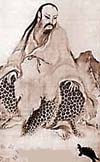
Fu Hsi
was the first of the legendary emperors of China who must have governed between 2852-2737 BC. According to the ancient Chinese tradition, he invented the eight trigrams ( pa-kua) that represent the foundation of the I-ching
system, and from which the hexagrams
derived.
- King Wen (Wen Wang)
Fu Hsi, the Divine Ancestor, author of pa-kua (the eight trigrams) |
The second important character in composing the I-ching is King Wen. Known as the founder of Chou dynasty (1150-249 BCE)
and a great scholar (his name also bears the significance of "civilization-king" or "scripture-king"), he is assigned the introduction of the 64 hexagrams, their names and the texts (Judgments) ascribed to them. King Wen compiled the new I-ching
during his detention ordered by Hsin, the sovereign who was overthrown by King Wen's son Wu. The name "I-ching" is contemporaneous with King Wen - the book couldn't bear this name before.
The texts of each individual line (composing the hexagrams) are the work of King Wen's son named
Tan, known also as the Duke of Chou. These are short description of lines and their meaning for the divinatory use.
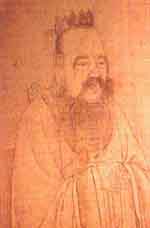
Confucius
and his disciples also contributed to the composition of I-ching. Tradition states he had used up at least three book rolls during his thorough study. Moreover, at the age of 50,
Confucius would have declared: "If Heaven gave me another 50 years to live, I would spend them studying I-ching and perhaps then I would beware myself of troubles."
The comments of the book, named "Ten Wings", are attributed to Confucius, or at least to his adherents. It is important to emphasize that the shape the book
took under the influence of the Confucian editors is the one we have today.
- I-ching in the West: Richard Wilhelm and Carl Jung
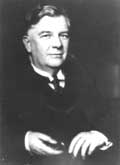
Richard Wilhelm, the well-known German translator and commentator of the I-ching |
One of the first translations of the I-ching in English was made by James Legge.Richard Wilhelm, a Protestant
missionary in China, translated the book into German under the direct guidance of a Confucian master, Lao Nai Hsuan. " I am indebted to him - Wilhelm wrote - not only for a
deeper understanding... but also because he first opened my mind to the wonders of the Book of Changes. Under his experienced guidance I wandered entranced through this
strange and yet familiar world. The translation of the text was made after detailed discussion." (R. Wilhelm, Introduction to the I-ching, Wilhelm/Baynes version, Princeton University Press, 1977.) This is the most known and referred version. The Wilhelm/Baynes English version is made upon the request of Carl Jung, the famous Swiss psychiatrist. Jung himself used the oracle and wrote a valuable introduction to the English version explaining how it
works and the method of interpreting the answers.
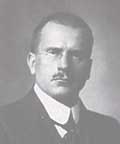
| Carl Jung wrote a substantial introductory essay to the Wilhelm/Baynes version |
Carl Jung suggested the Wilhelm/Baynes English version, and it was also him who added a substantial introduction to this
version, where he explained with personal examples the way the book works as oracle.This is the most important contribution to the explanation of the oracular practice to the western culture.
We have a lot of English versions of I-ching. Most of them follow the Wilhelm's translation style - others are
free adaptations. There are also a few versions which don't follow Wilhelm's or Legge's directions, but draw from the scientific interest in the book history, language and meaning.
I-ching applications may be found online. Thus we can consult the book without having to handle one of the consulting methods, with coins or yarrow stalk. Read more... Read also:
|