Who Was Lao-tzu? Lao-tzu was the father of Taoism which he taught in his Tao-te ching, according to tradition.
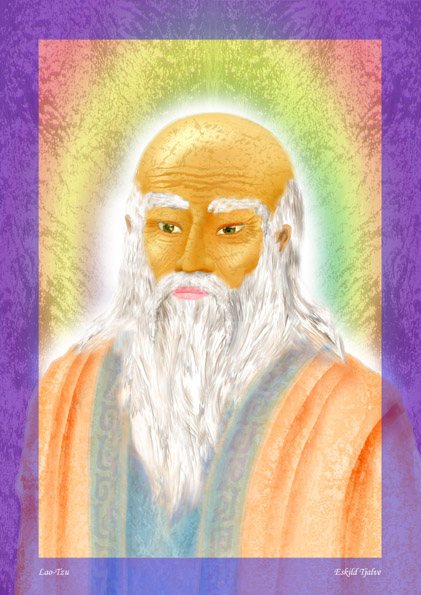
Lao-tzu by Eskild Tjalve
(click the painting to enlarge) |
Almost everything we know about Lao-tzu comes from the Historical Records of Ssu-ma Ch'ien.
Lao-tzu is also one of the basic characters of the Chuang-tzu's stories although they are mostly fiction. Biography
According to Ch'ien, Lao-tzu was a curator at the Royal Library in Chou. His surname was Li; his name was Erh (meaning ear) - this is why we find him also under the name of Li Erh. As for the "Lao-tzu" it is only a nickname meaning the Old (Venerable) Sage. Finally, he left the royal court and gone West. He met the Guardian of the mountain pass who asked him to compose a book of wisdom. This is how Tao-te ching took birth.Philosophy Lao-tzu preached the retirement from the turmoil of life and keeping a low profile. History records tell us that he met Confucius to have a discussion about rites.
On this occasion he taught him to show more reverence and simplicity as to keep alive. These notes are almost all we have about Lao-tzu from Ch'ien.There's no further indication concerning the life of the sage in the West; he simply gets out of our sight the minute he passes the boundary of the state of Chou. About Lao-tzu's Death We know nothing from a historical source about the death of Lao-tzu.
Surprisingly enough, Chuang-tzu still wrote a detailed story about this topic.Nonetheless - James Legge concludes - this narration might be just another of Chuang-tzu's fancies: "to give him the opportunity of setting forth what, according to his ideal of it, the life of a Taoist master should be, and how even Lao-tzu himself fell short of it".Lao-tzu and Tao-te ching in the West Lao-tzu's life as well as his work are continuously objets of dispute. This is why one finds many versions of his Book and controversial biographic accounts.
Therefore one may believe that the entire Taoist philosophy is but a timeless speculation depending on the ideological position of the specialists or their followers. Fact is that one can not understand the concepts presented by Lao-tzu in his book as long as one doesn't have any idea about the Taoist thought. Taoist ideas and concepts are not familiar in West. And what is worse is that these ideas are associated with the
New Age philosophy which has nothing to do with Taoism. Further Resources:
The best Book on Lao-tzu and Taoism:
- Max Kaltenmark is the best author who wrote about Master Lao. -> You may purchase this book from Amazon.com.
Learn Lao-tzu online with us
- By taking our online course dealing with these matters.
-> Click to access the course page.
--
Paper by Jhian
Last update: 07.10.2026 |