TaoPage.org | Home - Taoism
What is Taoism?
Taoism is a way of life inspired by the writings of Lao-tzu and Chuang-tzu, focused on the imperative of following the Tao, the absolute principle.
Two Kinds of Taoism
In fact, there are several kinds of Taoism. The most known is the religious branch (tao-chiao). It has gods, and rituals like any other religious system. It includes many mystical schools and esoteric disciplines searching for longevity and immortality, most of them dealing with alchemical recipes, sexual and breathing techniques.
Lao-tzu, the father of Taoism - author of Tao-te ching - heading West |
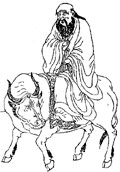
There's also the Tao-chia, meaning the philosophical Taoism, ascribed to the Lao-tzu and Tao-te ching.
Taoism and Tao-te ching
Everything we know about the Lao-tzu's Taoism - its concepts
and practices - come from Tao-te ching (The Classic of Tao and Te). This book explains what is Tao, the core concept of Taoism, its characteristics, and how the Taoist disciples must behave to emulate it in his own life. There's also the The Book of Changes (I-ching) is also part of the Taoist tradition as it was used for divination by Taoist disciples.
Taoism Vs Confucianism
Confucianism is interested in public life and insists on the transformation of the individual through culture and education. Future political leaders must be formed according to the principles dear to Confucius of humanism and rightness. The structure of the state is inspired by family relationships, and the conventions associated with them.
|
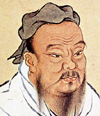 Confucius is the author of an ethical school aiming at the man transformation as to learn and follow the rites assigned to the future people working on behalf the state.
Lao-tzu's Taoism is interested in what is natural, raw, in human innate constitution. In this sense he rejects the political ideas of Confucius who is often criticized and ridiculed in the Taoist works, including the Tao-te ching.
A proof of the irreconcilable character of the two doctrines is the famous dialogue between Lao-tzu and Confucius related by
Ssu-ma Ch'ien.Confucius, who talks about the rites, is apostrophized by Lao-tzu who warns him that his intellectual pedantry may cost him his life. Rather, he must adopt a modest and reserved demeanor.
Taoism and the Western Culture
The religious Taoism resembles the Christian and other such religious systems. But the Tao-te ching's Taoism is not equaled by any known Western system. Western people don't seem to understand a spiritual system that does not have a god to be worshipped, does not impose rules of conduct, nor ethical imperatives. The misunderstanding of the spiritual Taoism explains why it is
presented like a historical movement rather than a living tradition.
|
 The Taoist teachings may be applied even today, on a day to day basis, in order to improve our capability to cope with our ever changing world and secure our lives.
Still Taoism is not outdated. One can follow this path today to find the cure for the insurmountable problems of the modern world.
About Taoist Retreats
Contrary to popular opinion, the practice of Taoism does not
necessarily require retreat, seclusion, worship and special diet receipts. One starts simply from here and now and acquires a new understanding of the world as it is, and the remedy to its pitfalls. The Taoists disciple of Lao-tzu doesn't even care about meditation and anything related to the spiritual practice. As stated by Alan Watts quoted above, they would do something for as long as they were attracted or curious, then move on to something else or simply go to sleep.
The Western disciple has a morbid attraction to what we might call systematic, long-term practice in the hope of achieving something usually vaguely or improperly defined. This is not the case with the Taoists of Lao-tzu's time, who were detached and self-sufficient, content to practice wu-wei (nonaction) and anonymity. If they lived alone, they did not bother to get a job and earn money. They were supported by disciples or they used to beg for food.
If they lived in a family and had no disciples, they were repudiated or in any case harshly scolded or mocked.
 |
Learn Taoism Online:
More structured information about Taoism may be found in our online course Lao-tzu and Tao-te ching Revealed. -> Explore the Taoism course.
|
Articles - Online coursesResources - Forum - Search - Contact --
Last revision: 10.08.2026. Way of Perfect Emptiness.
