Taoism > Yin-Yang


About Yin and Yang
 

Yin and yang are the most familiar terms to the Western public, being equally, or even better known than Tao-te ching or Lao-tzu.

Why are they so widespread by the media? One of the reasons, I think, is the esoteric halo surrounding them. Bored to death with the rationalism of the institutionalized Christianity, with Cartesianism and scientific rigor, the Western public blindly pursues whatever keeps a trace of dream or mystery.

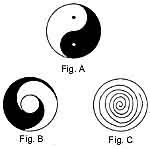
representations of T'ai-chi
Three ancient representations of T'ai-chi
or the Supreme Ultimate. Figure A stress the complementarity between yin and yang,
 figures B and C stress the dynamic
interaction between the two poles.
As a matter of fact, yin and yang are not mysterious, at least not for the Chinese. It is the multitude of meanings attributed to them that stirred confusion, attracting a sense of eccentricity.

On the other hand, this couple of opposite terms sounds quite familiar to the modern mind, which is intoxicated with dialectic. Dualism surpassed its religious, heretic stage and is now located in the realm of modern psychology and philosophy. We are only flattered to find this couple of opposites in the vocabulary of the Chinese philosophy: it proves that wherever we look, there is a single piece of truth - our truth.

So, what we have is the mysterious on one side, and the familiar, on the other. The success of this pair of terms is understandable now.

  • Brief History

According to Legge, yin and yang are not such old as one may think. They are not referred to directly in I-ching, except for the commentaries (Shih-I) on it.

In I-ching we find other words, that Legge translates by strong and weak, which denominate the linear traits ___ and _  _ that make trigrams. Legge also elucidates the meaning of yin and yang, derived from the sun and the moon, translated as bright and dark (1).

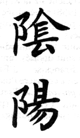
yin and yang graphs
Yin and Yang graphs
In Book 5, Chapter 2 from Lu-sih ch'un-ch'iu (Spring and Autumn Annals), we find a description of the way all things were generated from yin and yang:

    The Great One produces the two poles [i.e. Heaven and Earth], which in turn give rise to the energies of the dark (yin) and the light (yang). These two energies then transform themselves, one rising upwards, and the other descending downwards; they merge again and give rise to form. (2)

Lao-tzu mentions yin-yang polarity only once, in chapter 42 of Tao-te ching:

    The created universe carries the yin at its back
    and the yang in front;
    Through the union of the pervading principles it
    reaches harmony.
    (3)

In Chuang-tzu there are more references to yin and yang, and we are quoting here a very meaningful one:

    Yang or element of expansion in them is too much developed. Are they exceedingly irritated? the Yin or opposite element is too much developed. When those elements thus predominate in men, (it is as if) the four seasons were not to come (at their proper times), and the harmony of cold and heat were not to be maintained; would there not result injury to the bodies of men?(4)
     

  • Alan Watts on Yin and Yang

According to Allan Watts, there are two poles of the cosmic energies in the Chinese tradition - yang (positive), and yin (negative).

    More about yin-yang


    elearning experienceLearn more about Yin and Yang in Tao-te ching, I-ching and Taoism. Follow our 28-day online course on the Yin-Yang philosophy. more...


    your elearning experience

    The ideograms indicate the sunny and shady sides of a hill, fou, and they are associated with the masculine and the feminine, the firm and the yielling, the strong and the weak, the light and the dark, the rising and the falling, heaven and earth, and they are even recognized in such everyday matters as cooking as the spicy and the bland. (5)

Notes:
1. James Legge: I Ching - Book of Changes, Gramercy Books, 1996, p. 43.
2. The Shambhala Dictionary of Taoism, p. 218.
3. Tao-te ching, Lin Yutang's version.
4. James Legge, The Writings of Kwang-dze, Book XI, chap. 1, from The Texts of Taoism edited by F. Max Müller: The Sacred Books of the East.
5. Secular representation of the yin-yang polarity, illustrating the dialectic ideology that is so endearing to Western thought. Quotation from Alan Watts, Tao: The Watercourse Way, Pantheon Books, 1975, p. 21.


Home | Search | Online Courses | Resources | Newsletter

Copyright 1999-2008, Way of Perfect Emptiness. All rights reserved.

taopage logo